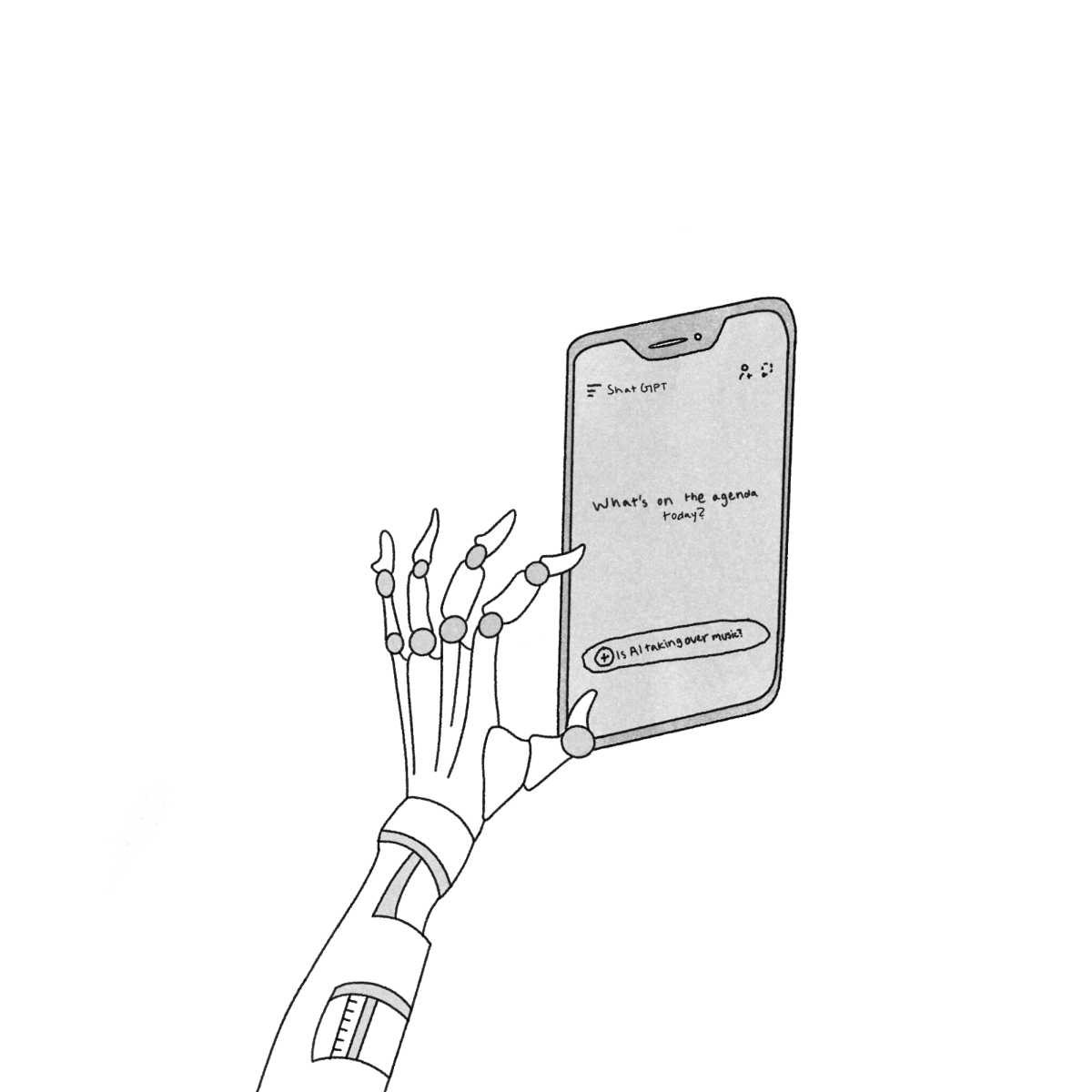
AI is not only ruining the quality of modern-day music but also the integrity of the arts.
From the fine arts to applied arts, the amount of creativity, emotion, and humanity that goes into creating a single piece of work is beyond what artificial intelligence can ever comprehend. To pass off a piece of AI music as being “real” and “creative” is an insult to the community.
Trying to pass off some AI-generated song is an insult to musicians and composers, especially.
As a musician and as a music performance major, the use of AI to create something that is supposed to otherwise be so personal and emotional—or supporting the use of AI in such ways—is unethical.
It’s hurting artists, both those who write or compose and those who perform.
Music is supposed to draw emotion from the story it holds.
Take Chaminade, for example. Cécile Chaminade was a French composer, famous for her commissioned piece “Concertino for Flute.” While it was commissioned for the Paris Conservatoire in 1902, legend largely states that she wrote it out of spite.
The legend is based around the idea that she wrote the piece for her ex-lover, a flutist himself, and was composed with his weaknesses in mind in order to ensure that he could never play it in its intended way, for the difficulty was beyond his skill.
While the myth was later debunked, it’s a story within a single song that many players, including myself, keep in mind when performing the piece.
Spite and anger are two emotions that I especially keep in the forefront of my mind while practicing, fueling the notes and the story that I’m helping to build and bring to life.
It’s pieces like this that are human. They are meant for humanity to perform. They are meant to stir these emotions and these feelings.
AI can’t replace it, and it shouldn’t. Take away the humanity of music, and you’re left with another falsity in a world full of them.
Drawing away from classical music, you have modern songs like Billie Eilish’s “TV,” a sad-toned song largely based around domestic solitude. It’s not supposed to be upbeat. It’s supposed to make you feel and relate to something bigger than yourself.
Another example is James Arthur’s “Train Wreck.”
Arthur wrote this song after a particularly dark time following his appearance on The X Factor in 2012.
This is a time when, admittedly, he was struggling mentally, on drugs, and looking for a way out. It’s meant to be a portrayal of his past self calling out for help. It’s supposed to make you feel despair or deeply rooted regret.
It’s a song whose notes are constructed from emotion.
AI takes away any sense of personality and humanity within a song. An AI-generated song cannot produce the same effect as an artist’s hard work.
There was an “artist” on Spotify, Sienna Rose, who was quickly gaining popularity on the app with 4.2 million listeners. Only, it was recently discovered that she wasn’t an artist at all. AI was to be found behind the name.
Sienna Rose, the R&B and soul “singer,” gained popularity in late 2025 and early 2026 before it was revealed on platforms that AI was behind it.
I saw on TikTok that people are outraged. Her music was on their playlist. It was something they enjoyed, something that made them feel, and something they could relate to.
The second they found out it was AI, they were angry, and why shouldn’t they be?
It’s almost like a betrayal of sorts for this connection to be revealed as nothing more than a lie.
Now I don’t support AI or the use of it in general, but using AI to create music is something that needs to be spoken about more. Whether you’re simply a consumer of music or a creator, we should not support this.
Preserve the integrity of music and the arts as a whole. Support, instead, those who have put effort and emotion into every chord or every brush stroke.
Support those who take the time to truly create, not just click a button and post a generated song.