Millikin’s 17th president, Dr. Dean Pribbenow, vows to push Millikin forward in his time in office.
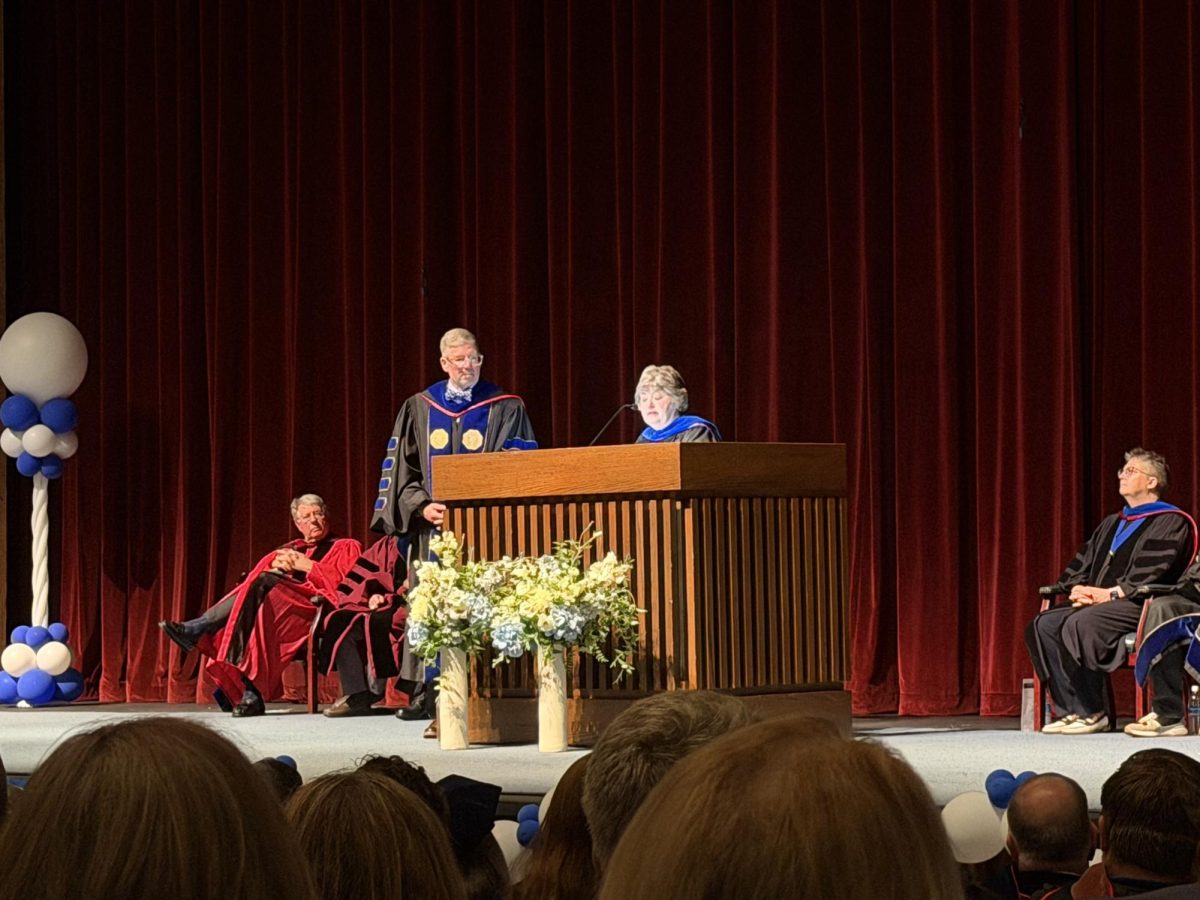
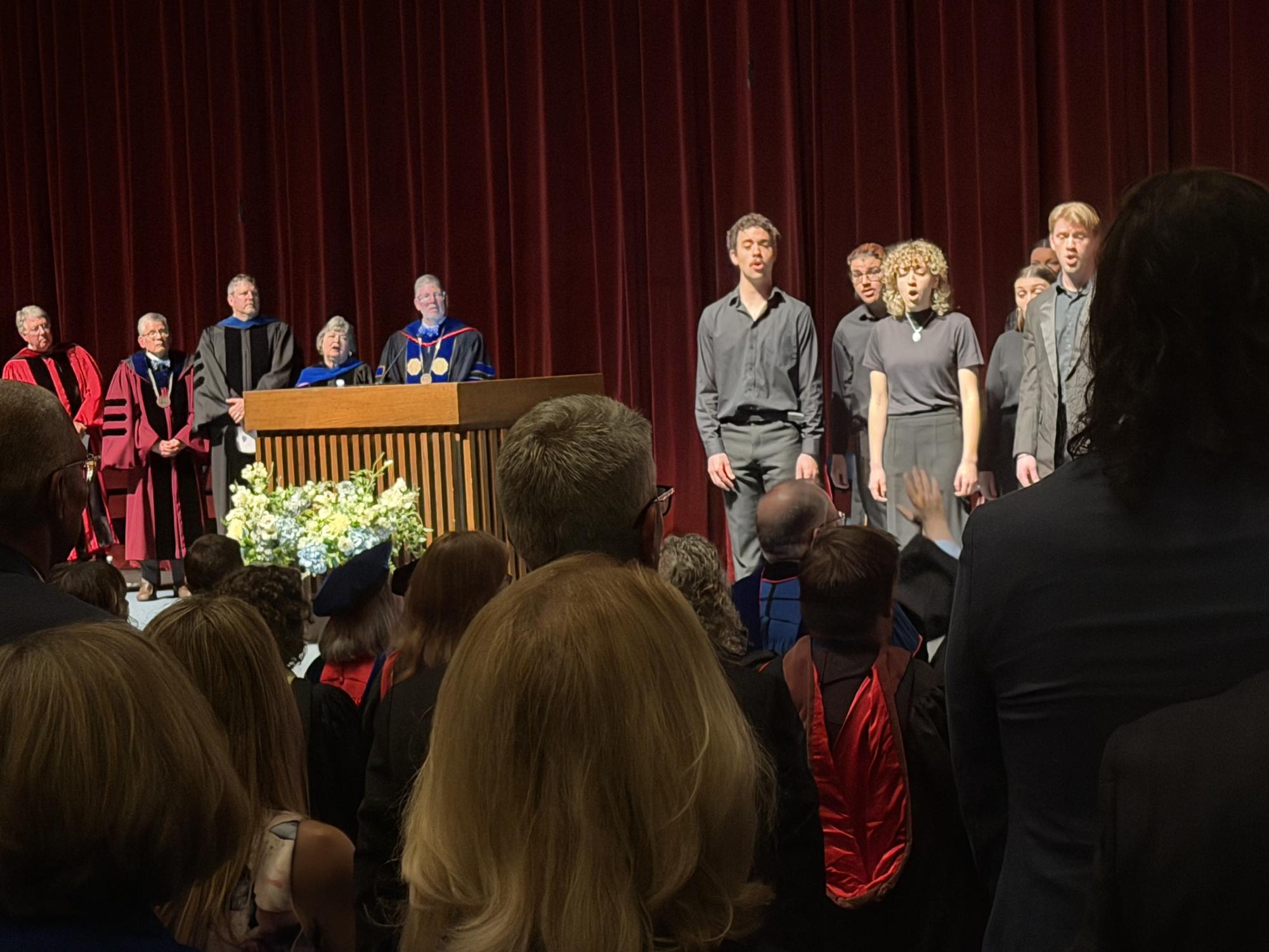
On Friday, April 10th, Pribbenow was officially inaugurated as Millikin’s president. There were many speakers who introduced Pribbenow, and one sentiment stayed true throughout their speeches: Pribbenow is ready for the role of president, and the speakers believe in him.
Pribbenow’s brother, Dr. Paul Pribbenow, presented a speech titled “Called for a Moment Such as This,” where he assured the audience that Millikin is in good hands with Dean.
“Dean does love you all,” Paul said. “He wouldn’t be here if that [weren’t] the case, but his stewardship will also challenge and inspire you to embrace your past without nostalgia and to imagine your future with clear eyes and hearts. He will guide you in the important labors of love that involve appreciative inquiry, critical reflection, reconciliation with each other and your past, and courageous, perhaps even bold and audacious actions to secure your future as a university.”
As the main part of the ceremony, Pribbenow gave a speech about his commitment to move Millikin in the right direction.
Pribbenow proposed four ways to move Millikin in the right direction: continue to focus on the students, expand the population of students who attend Millikin, aid the employment issues in surrounding areas by partnering with companies and employing students after graduation, and continue to partner with local companies to better the community.
“First, we must be student-ready,” Pribbenow said. “To thrive, we must first be student-ready [and] prepared for the unique demands of the traditional undergraduates entering our halls.”
Pribbenow then spoke about how Millikin can efficiently become student-ready and tailor its services to students.
“Tia Brown McNair and her co-authors offer guidance; becoming a student at a university requires us to transform our institutional culture to meet these contemporary realities, and we are already building this foundation through direct admission initiatives and tuition reduction models and enhanced summer bridge programs,” Pribbenow said. “Moving forward, we must scale these efforts by ensuring our advising is seamless and coordinated while continuingly evolving our curriculum. This means developing new majors that respond to employer demands and proactively preparing our graduates for a professional landscape where AI is no longer a novelty but ubiquitous.”
Pribbenow’s next initiative is to expand the types of students who come to Millikin.
“Our second imperative [is that] we must evolve to serve new and expanding populations of students,” Pribbenow said. “Recent data from the 2026 Landscape of Higher Education report is clear. ‘Institutions that cling to historic student pipelines and insist on trying to hold on to the status quo will face contraction [and] growth, and enrollment will be concentrated in adult learners seeking rapid re-skilling high school students accelerating through dual enrollment, and millions of Americans with some college and no credential; it is no longer optional.’ We must expand upon who we serve and how we serve them.”
Millikin has already begun this work by making agreements with community colleges like Richland Community College, Lincoln Land Community College, Heartland Community College, and more community colleges surrounding Decatur.
These agreements allow students to smoothly transfer to Millikin after their time in community college. These agreements have ultimately resulted in a rise in Millikin’s transfer enrollment.
In another attempt to reach a wider variety of students, Millikin has also launched a new master’s program.
“This is only in the beginning; with graduate students currently representing less than 7% of our overall student population, we see immense potential for growth in areas such as education, business, and health sciences, and by deepening our community college partnerships through dual admission and expanding our online and hybrid delivery… models, we will meet students where they are at all, while remaining fiercely loyal to our core mission and our values,” Pribbenow said.
Pribbenow then transitioned into ways he can move Millikin forward while also aiding Decatur and the companies based here.
“Our third imperative is this: we must align existing and new academic offerings intentionally designed to meet the economic and workforce needs of Decatur, Macon County, and Central Illinois,” Pribbenow said. “Early in my presidency, I attended a strategic growth round table… [and] over 40 leaders from Decatur [and] Macon County attended, representing sectors including education, industry, manufacturing, government, and others. A resounding theme emerged in those conversations and conversations since the urgent need for workforce and economic development across all sectors.”
Instead of sending Millikin graduates away after college, Pribbenow is proposing that Millikin should work together with companies in the Decatur community to employ students after graduation in hopes of helping their company and employment.
“To address these needs more assertively, we are shifting from passive alignment to active partnership,” Pribbenow said. “Our recent scholarship agreement with Decatur Memorial Hospital is a prime example.”
In exchange for funding, nursing students at Millikin who are in the Millikin University Nursing Scholars Program work for three years at Decatur Memorial Hospital after the program. This is in an effort to aid nursing shortages.
Millikin has also recently added an accelerated online elementary education program to combat the teaching shortage.
Pribbenow’s final proposal also includes continuing and creating partnerships with Decatur and those in the Decatur community.
“My final imperative is this: we must boldly pursue external partnerships that reflect our role as an anchor institution,” Pribbenow said. “As this area’s seventh largest employer, we have a long-term commitment to leverage our assets for the betterment of the community. We see this commitment in action every day. Our employees serve on community boards. Our students are engaged in local internships.”
Pribbenow provided a direct example of these partnerships he wants to see more of. Millikin has partnered with the Golden Rule and the City of Decatur to start the Decatur Baseball Club. The team, the Bean Ballers, will play at Workman Family Baseball Field, acting as its home field as well.
Pribbenow also mentioned the Millikin Market as an example of Millikin’s partnership with the Decatur community. The Millikin Market addresses food insecurity on campus, and some of the funding for the market is provided by Decatur-based companies.
“These successes and others prove that our deepening engagement can serve as a powerful model for the entire region,” Pribbenow said. “Looking forward, we must ask ourselves, ‘How can we further integrate into the fabric of the community? Are there untapped opportunities for degree and connection, credential-based partnerships with local businesses or ways to share space with private entities? Can we play a more direct role in the revitalization of neighborhoods like Oakwood or leverage our expertise to deliver better services to local industry? Could stronger governmental relationships lead to increased support for priorities?’”
All of the key points he featured in his speech provide Millikin students with Pribbenow’s plan to improve Millikin while also building off the current structure.
“We will move Millikin forward; transformed by these four imperatives, we will be student-ready,” Pribbenow said. “We will enroll new student populations. We will meet regional economic and workforce needs. We will expand external partnerships, tradition, and transformation.”