
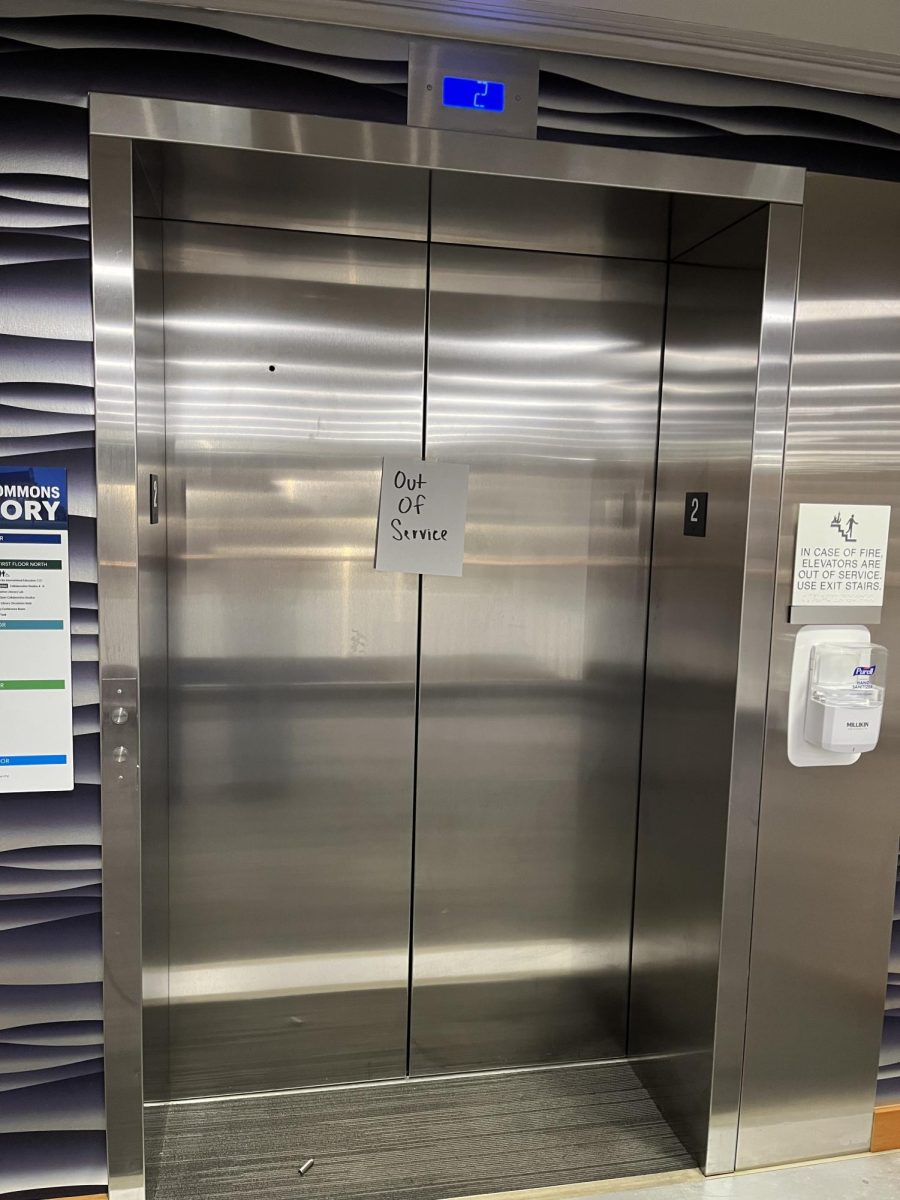
Over the last couple of months, all of Millikin’s employees and students have received a long series of emails regarding elevators on campus breaking down.
When an elevator on campus breaks down, students get an email notifying them, and another when it is fixed.
Students with physical disabilities rely on the elevators on campus working to get to class, but it’s not just students using the elevator; it’s most students, staff, and faculty.
President Dean Pribbenow has been working with staff at Millikin to fix the elevators and get the word out across campus when one is broken.
“When the elevators do become inoperable, we try to respond to them as quickly as we can, and we also try to notify the campus as quickly as we can when that happens,” Pribbenow said.
Elaine McLaughlin, a creative writing major, uses a cane, and the elevators on campus help her get where she needs to be.
“It’s very difficult being someone who uses a mobility aid and needing those elevators to be reliable in order to get to work, to class, [or] anywhere I need to be,” McLaughlin said.
McLaughlin can get to class using the stairs, but it takes them much longer than it would take other students and sometimes can prevent them from getting to where they need to be on time.
Isabella Blohm, a creative writing major, has asthma and joint issues, which make taking the stairs difficult.
“It’s like if I can’t use the elevator, I guess I’m just not going to class,” Blohm said. “And that’s how it is for a lot of other people.”
Having accessible routes on campus is important, but when those routes are out of order, students must pick and choose their battles.
Some students who get an email about an elevator being down decide to skip class, which not only affects their education but also their sense of belonging at their university. Accessibility isn’t a privilege. It’s a standard.
“I couldn’t imagine getting around this campus in a wheelchair sometimes, because as someone who’s using a cane, sometimes I can opt to take just a couple of stairs if I need to,” McLaughlin said. “But not everybody has that choice, and I think it’s really something that needs to be talked out about and recognized.”
Although students with disabilities can get around campus, it takes them much longer, usually meaning that they have to walk to a door with an automatic button or down a winding ramp.
They usually have to make a detour to be able to get to the same place as their peers. All students can take a ramp or elevator instead of the stairs, but it is not true the other way around.
“Disabled students should be able to get to class in the same amount of time it takes an able-bodied student, and the infrastructure around here just does not allow that,” Blohm said.
The elevators being down have been the most prominent and inconvenient part of accessibility on campus. What most students want to know is why the elevators are down.
“Amy Besser, who is our Vice President for Finance and Operations, oversees that area, and I know that she’s working pretty diligently on trying to be more responsive, because in my perception, the elevators in general are breaking down way too often, and not just in one building,” Pribbenow said.
So far this semester, elevators have been breaking down in Shilling Hall, the University Commons, Dolson Hall, and the Leighty Tabor Science Center. Because of this constant issue, many are trying to find a solution.
“One of the things we are looking at doing in the next few months is developing what’s called a deferred maintenance plan,” Pribbenow said. “And what that is is we have somebody come in and do an assessment of all of our buildings to help us understand where we have the greatest needs.”
One of the focuses of this plan would be Shilling Hall, because of how old the building is and how busy it is with various classes and many staff and faculty offices.
“What my interest would be doing would be how do we approach this more comprehensively, as opposed to being reactive when waiting till something breaks down to fix it,” Pribbenow said.
In the meantime, Pribbenow suggests that students who are unable to get to class due to an elevator being down should communicate with their professor and reach out to Student Affairs if they have any further concerns.
The elevators being down is a problem, but hopefully one that won’t last much longer.
To keep up to date with everything Decaturian, follow the Dec on all socials.
Facebook: https://www.facebook.com/Decaturian
Instagram: https://www.instagram.com/thedecaturian/
TikTok: https://www.tiktok.com/@the.decaturian