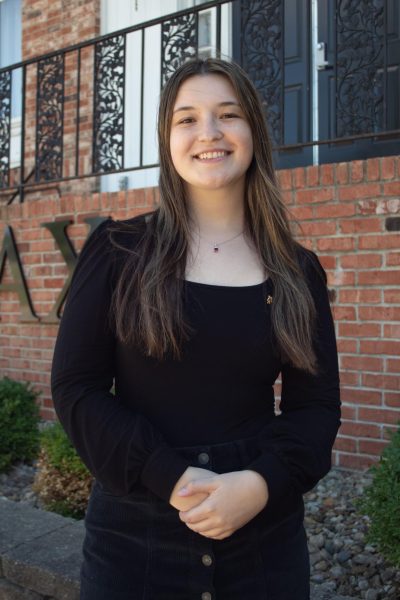

After 52 years of teaching and 38 years at Millikin, Dr. James Rauff is retiring.
“It takes a lot of energy to teach, and [I’m] starting to lose my edge,” Rauff said. “So I get to the end of the day, and it was, ‘I’m tired,’ so it was time. I think I’ve done a good job, and I also wanted to go out the door when people were going to be sad rather than happy.”
Rauff is a Professor of Mathematics and Computer Science at Millikin, but he didn’t start his education journey with teaching in mind.
After receiving a B.A. in Mathematics from Albion College, he eventually found himself in graduate school.
“I went to grad school, initially in mathematics, to avoid getting drafted into Vietnam,” he said. “So, that was to maintain a student deferment.”
When he got to the University of Wyoming, where he eventually received his M.A. in Mathematics, he worked a teaching assistantship. This is where he found his love for teaching.
“The week before classes, they handed me a college algebra book and said, ‘You’re going to teach this.’ I never taught a thing in my life,” he said. “The first week I finished that class, I knew that was what I was going to do for the rest of my life. It was so much fun. So that’s how I got into teaching. It was totally random.”
From then to now, his philosophy and love for teaching have grown exponentially.
“My philosophy of teaching is [that I] always assume that my students can understand what I hope they can understand,” Rauff said. “It’s my job to figure out how I can help them understand it, so I do not accept I can’t do math as an excuse from anybody.”
Rauff didn’t start teaching at Millikin, though. His first job was at The College of Lake County, a community college.
“I was getting tired at the junior college of seeing students for two years that would just transfer,” he said. “They transfer somewhere, and they would start in math and in computer science. It takes about two years before [students] start doing something real, and they were just starting to get it, and then they go away. I just want to follow them through. I want to see them get to the finish line. So I started looking for four-year schools to get into, and Millikin had a nice combination of math and computer science that I could do.”
Dr. Joe Stickles, Professor of Mathematics and the Director of the School of Mathematics and Computational Sciences, was Rauff’s student in 1989. Stickles was able to see firsthand how Rauff’s teaching style works in the classroom.
Not only has his past student-teacher relationship helped Stickles in his own teaching journey, but throughout time, he and Rauff have developed a deeper relationship.
“It’s a very bittersweet feeling,” Stickles said. “I’m also an alum of Millikin, and he was the very first professor I had in my very first class at Millikin. So that was back in 1989, a long time ago. So yeah, it’s bittersweet… He’s been a great mentor. I modeled my teaching style after him, all of that good stuff… I’m very happy for him that he’s able to retire.”
Throughout the many years they have known each other, Stickles and Rauff share many memories, but one of Stickles’ favorite memories of Rauff is from his collegiate years.
“One of my favorite memories is that he was always willing to work individually with students,” Stickles said. “So by the time I was a junior, I was doing a lot of independent studies that were above and beyond… One of my favorite things is that I was in his office a lot, sitting basically where you are, right across [from him], but I wasn’t asking questions. I would just work… He was always willing to let me just work in there. Well, one day he needed to get up and go, presumably, to a meeting, but he gets up [and says], ‘I’m going to take off, but if anybody shows up, just help them.’ So that was kind of how I modeled my career after that, basically, if anybody comes in, help them.”
Throughout his years of teaching, Rauff has helped many students. Not only has he helped them, but he has also tried to meet students where they are and not ridicule them for not understanding material the first time around.
“I had a student here who graduated in 2016 who wanted to be an actuary, so she was an actuarial science major,” he said. “She really had a hard time with some of the math courses. We spent a lot of time out in this suite on chalkboards, doing problems, working, working, working, working, working, and she made it through and has become a super success in her field. And she’s managing billion-dollar accounts. She’s actually endowed a scholarship here at Millikin, so that was really a joy, because that was a person who was really working hard and having a hard time at it, but didn’t give up. I didn’t give up on her, and we made it through.”
Teaching math, a subject that is largely black and white or right and wrong, might burn some educators out quickly. Rauff taught a lot of the same subjects over and over again throughout his years at Millikin, and some educators may get bored with this repetition after a while. But even if Rauff got tired of teaching the same subjects over and over, he never let his enthusiasm for the subjects dim.
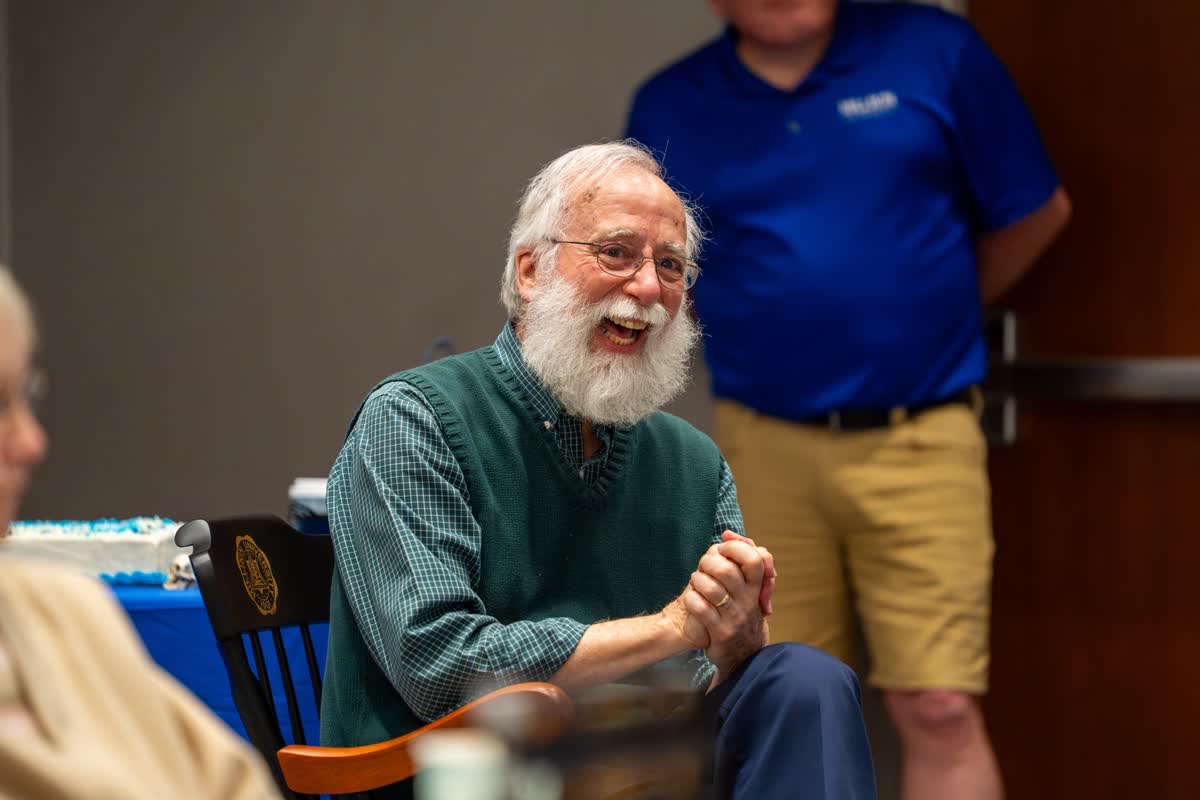
“The first thing that comes to mind is the importance of enthusiasm; the students who are in front of us want to learn and need us to be excited about the topic in order to facilitate some of that learning,” Dr. Emily Olson, Associate of Mathematics, said. “And I think in 38 years, [Rauff] hasn’t dropped an ounce of enthusiasm for all the subjects that he’s taught, and that’s a huge variety of topics as well. So I talk to him a lot about mathematics, because I’m a math professor, but he teaches computer science. He has taught anthropology, he’s taught honor seminars, and so in any of these areas, he’s passionate about the content, passionate about teaching, and wants to pass along that knowledge to all of his students.”
Although Rauff’s teaching career featured some repeated classes, he did have the opportunity to offer unique classes.
“I think probably my favorite course that I’ve had here was an honors seminar [about] infinity that I did for several years,” Rauff said. “And it was a joy because it was so interdisciplinary in content and in students. I had theater students, English majors, music students, scientists, business [majors], nurses, and the whole gamut. It was a really good opportunity for me to meet people outside of my little math circle.”
After being here for 38 years, Rauff has seen the various changes Millikin has gone through.
The most notable changes have been within the community Millikin strives to create.
“There’s been a shift in the faculty community over the years,” he said. “When I first came here, there was a faculty lounge down the hall here in Shilling that was open to everybody on campus… So you would go in there, and you would see faculty from all around campus. So in my first few years, I knew every faculty member by sight and by name, because I ran into them all the time, [but] that’s changed. Part of that is me. Part of it is buildings. There are some people who are faculty, [and] I don’t know who they are.”
Not only has the community within the faculty changed, but the way students interact and the community they build in classes has shifted due to technology.
“Students have evolved, and I don’t know if this is true of your classes or not, but when I would come to a class, if I was late, which I try not to be, but if I was late, there’d be a lot of chatter going on in the class, and then I’d have to settle everybody down to get started,” Rauff said. “Now, when I come to class late, everybody is on their phones, and they’re not talking… students are not building a community.”
There have been many changes throughout the years Rauff has been on campus, but the one thing that hasn’t changed is the quality of students who attend Millikin.
“What hasn’t changed is the students at Millikin,” he said. “You are the nicest, most respectful people… I have always been impressed with how great you are. How you treat each other, for the most part, with respect, and how you treat your faculty with respect. I’ve seen students joking around with Einstein’s workers, the groundskeepers. The community part of the university is still intact; people just need to keep it going.”
Rauff has been one of the only constants Millikin has had for many years, and with his retirement, he leaves behind beloved colleagues and a big hole to fill.
“There’s a lot of institutional knowledge that is held in folks who have been at one place for a long time,” Olson said. “So I think we will spend quite a bit of next year deciding, do we reach out about this? You know, should we ask Jim? But he has also known that he can pass along his knowledge. And so for this last year, he has made sure that we know how to fill in the things that he had been in charge of. I think we’re in a good place to continue those things and continue to develop them, and get his input if we think that’s needed.”
The Math Department has already hired a new professor to fill Rauff’s position. But even though his position has been filled, Rauff leaves behind something much more valuable than simply teaching a class. He leaves behind a legacy.
“It is very clear that his legacy is huge at Millikin, that there have been so many alumni who have heard about the retirement and started reaching out with stories and explaining where they still use nuggets of wisdom from Dr. Rauff in their lives, you know?” Olson said. “And that feels really special. I am not close to retirement at all, but it’s interesting to kind of see where that path of being a college professor could take me, you know, one day of having been involved in so many students’ lives.”
Rauff has changed many people’s lives, whether that be a student, a professor, or an administrator. And he is not done changing lives yet. He has one more large responsibility he must complete: the spring commencement speech.
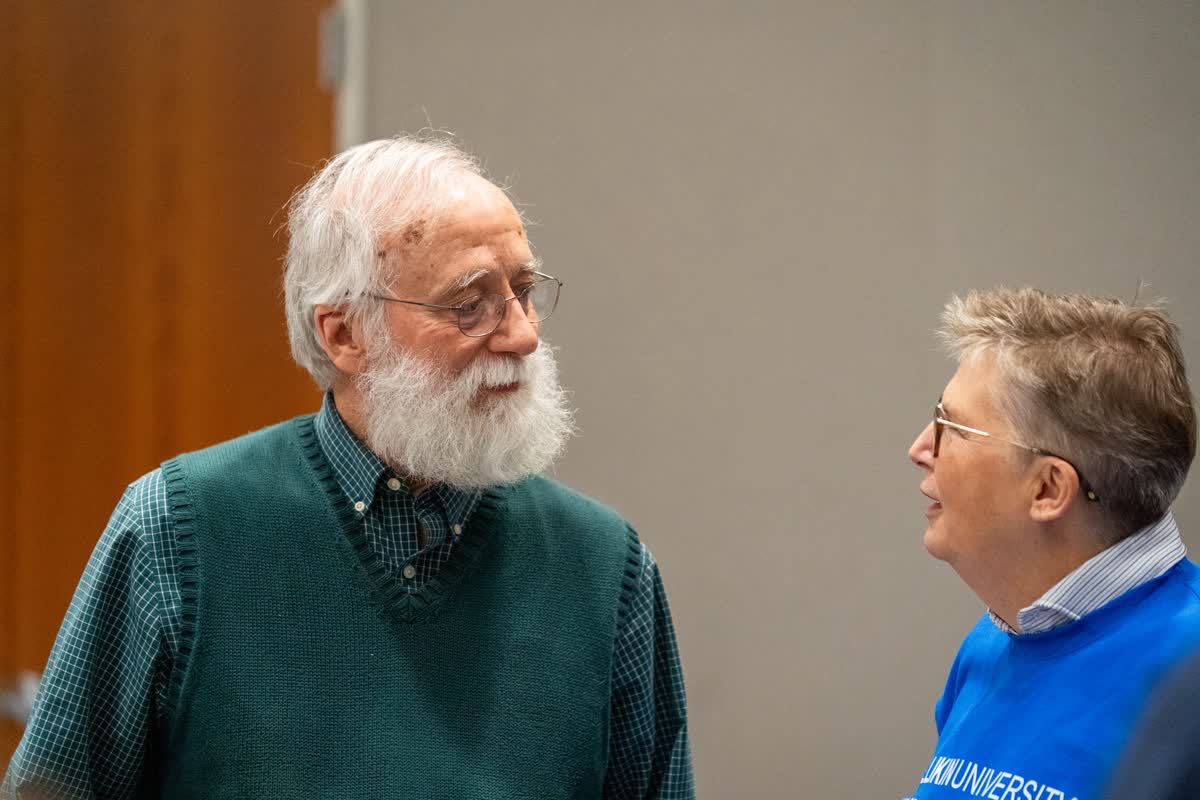
“I feel really super honored and humbled that I would be asked, and then terrified to [give the speech],” Rauff said.
Commencement will be one of Rauff’s last teaching opportunities on campus. After this speech, he will have all the time in the world to travel, continue his research, and hopefully find ways to keep teaching others.
Serving 38 years at an institution is a huge feat, and even though his colleagues are going to miss him, they are excited to see what he does next.
“I’m excited for him,” Olson said. “We’re going to be sad [and] miss him, but retirement can open up also a lot of new doors where you might be excited to go do research, travel, or do more reading. There’s still a whole other phase of life ahead for him, and I wish him really well in that next adventure.”
To keep up to date with everything Decaturian, follow the Dec on all socials.
Facebook: https://www.facebook.com/Decaturian
Instagram: https://www.instagram.com/thedecaturian/