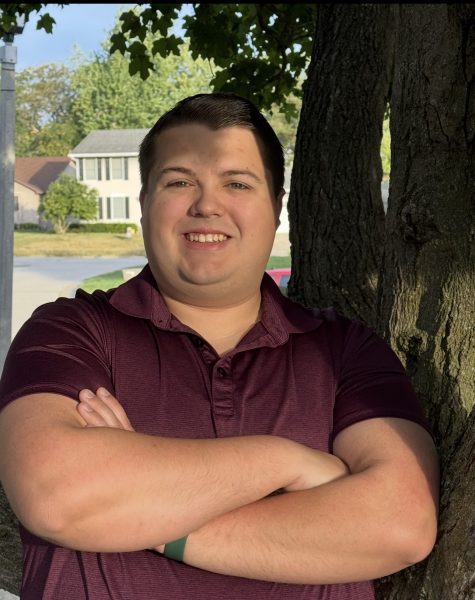

Learn about the man who signs every email with a dollar sign.
On the fourth floor of Shilling Hall, down the west hall, you’ll probably hear ecstatic yelling and a roar of students laughing. If you follow the noise, you’ll find the culprit to be none other than Dr. Robert E. Money Jr.
At Millikin University, Money has earned a reputation not only as a passionate philosophy and pre-law professor but also as a mentor whose guidance continues to shape students long after they leave campus.
Born in Mobile, Alabama, Dr. Money traces much of his personality back to the place he started. He grew up moving frequently, living in Mobile, Alabama; Darlington, South Carolina; Winston-Salem, North Carolina; Knoxville, Tennessee; Greenville, South Carolina; Atlanta, Georgia; and Iowa City, Iowa. His wife, Rhonda Money, refers to him as a “rootless wonder.” Throughout all the moves in his life, Money finally found a place to plant his roots.
“I have been at Millikin since the fall of 1999,” Money said. “I came straight from the University of Iowa, and I’ve been here ever since.”
As a young kid, Money envisioned a future in the courtroom. His dream was to become a judge. This dream, like many of ours, was rooted in family influence.
“My uncle, my mom’s brother, was an attorney,” Money said. “I still recall when we would visit my grandparents, he’d come over, and conversation would eventually turn to cases that he was involved with.”
His uncle’s cases became enchanting tales that filled Money with wonder.
“I remember one in particular,” Money said. “This lady had her hair up. Apparently, she had very long hair, got on a combine doing outside field work, and her hair got loose and trapped. It peeled her whole scalp back off. There was some sort of lawsuit against the manufacturer of the combine. Things like that were dinner table conversation, and you’re like, ‘Oh my god.’”
These stories led Money to pursue a legal career, but first, he had to make his way through rigorous schooling.
“I got a BA double major in philosophy and political science from Furman University,” he said. “After that, I got my law degree from Emory University.”
Teaching was never something he had envisioned for himself. That changed during his junior year of college, when a single course changed the trajectory of his life.
“I had a teacher,” Money said. “I can date it to my junior year of undergraduate. I had taken a couple of philosophy classes before, but I took a class called Law, Justice, and the State with James Edwards.”
He said he enrolled simply because the course title sounded intriguing, but what he encountered was something far more interesting.
“It was totally different from any other academic course I’d ever taken,” Money said. “He was fantastic. He was a marvelous teacher. We read Plato’s Republic and John Rawls’ A Theory of Justice. After that, I tried to take as many classes of his as I could.”
Edwards planted a seed that turned into a revelation. After completing law school, Money went on to the University of Iowa, where he earned both a master’s degree and a PhD in philosophy. From there, he came directly to Millikin. His legal aspirations became a memory as his focus changed to teaching and mentoring students.

Ask any student who has had one of his classes about his teaching style. They will immediately tell you about how distinctive it is. Some teachers are anti-AI, but Money is anti-technology. He does not rely on PowerPoint slides or online modules. He’ll choose a physical copy of a book any day of the week.
“I can’t stand PowerPoint,” Money said. “I don’t like recording lectures. I don’t like online learning. I think that’s a joke. I take a chalkboard and put my notes up on the board. I sure as hell want a chalkboard and not a whiteboard. I don’t like whiteboards at all.”
While some might see this approach as outdated, many of his students would disagree. Senior Katie Janvrin, a digital media marketing major with pre-law and political science minors, describes Money’s classroom in the best way.
“Dr. Money’s teaching style is very engaging and fun,” Janvrin said. “He takes ideas from the readings and breaks them down in ways that actually make sense, using examples and analogies that help connect everything. Class time is mostly discussion-based, so it feels like we’re actively working through the material together instead of just listening to lectures or doing busy work outside of class.”
What sets Money apart from his other professors, who share his wing of the Shilling, is his use of showmanship.
“He’s often very animated and theatrical when teaching,” Janvrin said. “That makes students even more invested in the material.”
Freshman political science major Jaskeerat Singh said Money’s ability to translate complex ideas is what stands out the most to him.
“He’s incredibly engaging, and he really makes sure that he doesn’t complicate us with his legal jargon,” Singh said. “He explains things in layman’s terms so everyone can understand what he’s saying.”
Singh also weighed in on Dr. Money’s use of the chalkboard.
“He should stick to it personally,” Singh said. “I was going to go into [Philosophy of Law] using a laptop, but I think you perform the best in a Dr. Money class if you just stick to pre-technology.”
One of Money’s noteworthy contributions to Millikin is the moot court program, where his role shifts from professor to coach. Moot court is a competition that simulates appellate legal reasoning, placing students in the role of attorneys arguing before a mock Supreme Court.
“You get a case file,” Money said. “It has a fact pattern, a circuit court ruling, and an appellate court ruling. Then you’re taking it to the next level. Students have to learn teamwork skills, partnership skills, communication skills, reading skills, logical reasoning skills, [and] rhetorical skills.”
Dr. Money took over the moot court program in 2003; only back then, it was an extracurricular activity.
“It wasn’t a class,” Money said. “Students got no credit for it. We met five or six in the afternoon until eight or eight thirty at night, a couple times a week.”
Recognizing its academic value, Money pushed to integrate moot court into the curriculum.
“There’s no way students shouldn’t be getting credit for this,” he said. “This is high-end academic achievement.”
Thanks to Money, moot court is now a 300-credit course taught every spring. The class is one of the most crucial experiences for students interested in law, and luckily, they have the right captain guiding the ship.
“[Dr. Money] is extremely involved in moot court,” Janvrin said. “He actively works through the case with the students, analyzing and discussing it in depth. His dedication is clear through the amount of time, preparation, and effort he puts into ensuring students are confident and successful when it comes to presenting their arguments in moot court.”
For Money, mentorship does not end when a student leaves Millikin. Former students frequently reach out years later for advice, reflection, or reassurance.
“One student graduated, went to law school, and got hired at a firm in New York City,” Money said. “Several years later, he called me while I was shopping with my wife and asked if I’d just be willing to listen to him while he decompressed.”
It’s special moments like those that can bring a smile to any educator’s face.
“He felt he could trust me,” Dr. Money said. “That’s not something I take lightly.”
He also receives emails from former students who are reminded of his classes through the oddest things.
“I had a former student who watched the show Severance,” Money said. “It reminded him of a topic we covered in class on personal identity. I like that they remembered the class and saw the relevance. That’s really cool. It’s pretty touching.”
Stories like that make current students like Janvrin feel confident that Money can shape their confidence.
“He’s been a mentor to me in a lot of ways,” she said. “He helped me grow more confident in my own ideas. I’ve never felt hesitant to ask questions or share my thoughts in his classes because of the environment he creates.”
Outside of Millikin, Money is a devoted husband and father. He met his wife, Rhonda, while attending law school. Coincidentally, they both graduated from Furman University, but at different times.
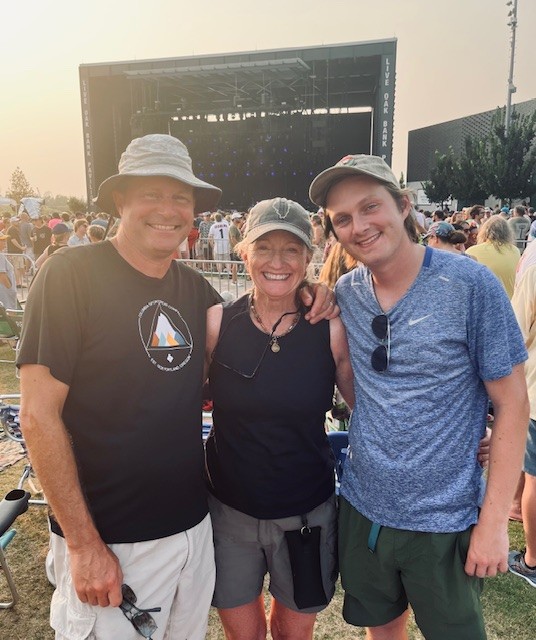
“We started dating in 1991,” he said. “Got married in ’93 and then moved to Iowa.”
The transition from the South to the Midwest was memorable, especially during Dr. Money’s first Midwest blizzard.
“I turned on the TV, and they were talking about wind chills being life-threatening,” Money said. “There are all the schools that are canceled, [and] then [the TV said] the University of Iowa will hold classes. I was like, ‘Not my Alabama ass.’”
Although growing up, he was the captain of his basketball team and played baseball in the spring, Money’s true love was for the Crimson Tide. Money is a lifelong Alabama football fan, a passion passed down from his father.
“I was raised by my dad,” he said. “My indoctrination into college football was through him.”
Outside of football, music plays an essential role in his life, particularly rock bands.
“I’m big into Phish,” Money said. “My son got me turned on to them. I grew up with the Allman Brothers and the Grateful Dead.”
Given his charismatic personality and everything he has done for Millikin’s pre-law program, it’s no wonder that students enjoy his classes.
“I will remember Dr. Money as one of my favorite professors at Millikin,” Janvrin said. “I’ve taken almost all of the classes he teaches, and every semester, they’re the ones I look forward to the most.”
However, even if Money wasn’t your favorite professor, he only cares that his students remember him as “interesting.” Rather than being remembered in a certain way, he hopes students leave his class thinking differently than when they arrived.
After 26 years of being rooted in a private institution, Money still enjoys his job.
“The best thing about my job at Millikin [is] the freedom to decide what I want to teach and when I want to teach it,” Money said.
Life is full of changes from locations to majors to career choices, but mentors stay with you forever.
Money has created a legacy that proves once and for all that the old saying is true: Money is the best motivator.